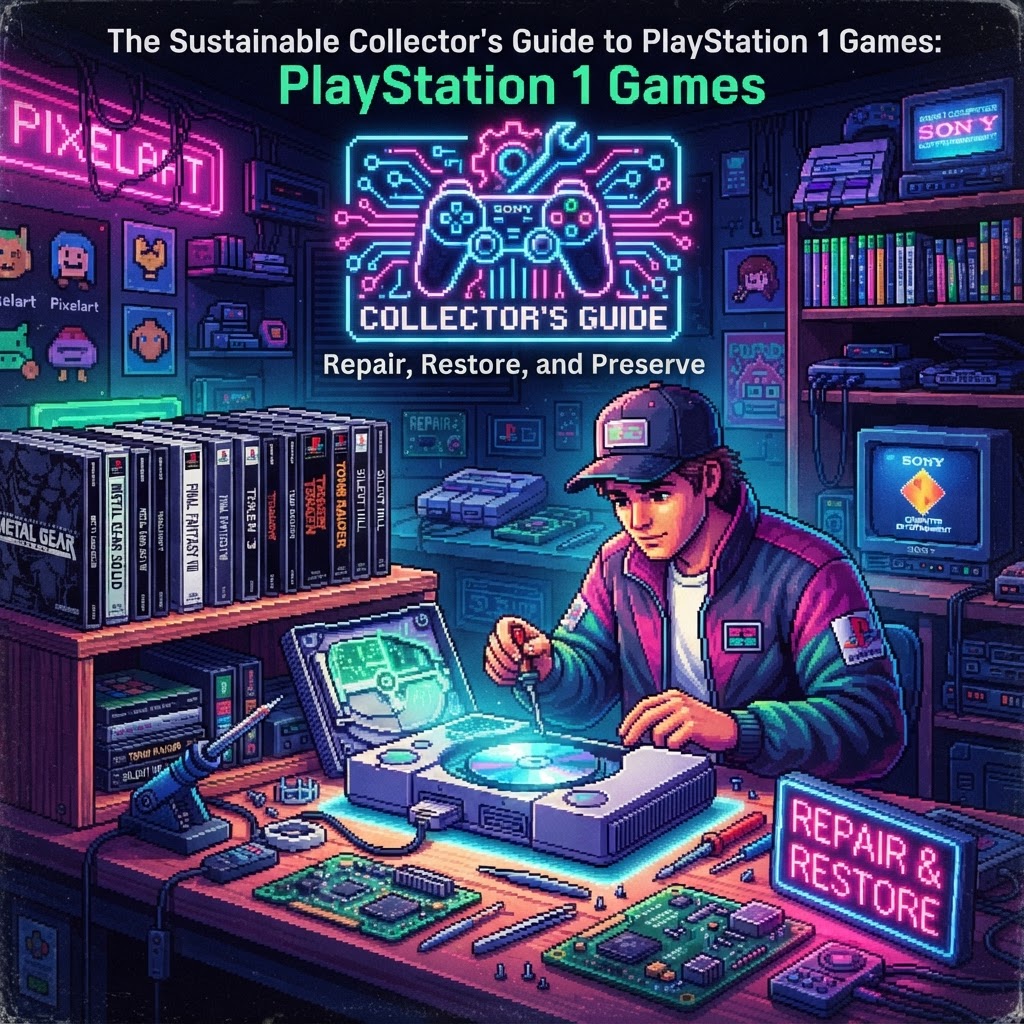
Why a Sustainable Approach to PS1 Collecting Matters
The PlayStation 1 launched in North America in 1995 and went on to sell over 102 million units worldwide. Decades later, original PS1 hardware and game discs are finite resources. Every console thrown away, every disc scratched beyond recognition, every controller tossed in a landfill represents an irreplaceable piece of gaming history lost forever.
The most respected collectors aren't necessarily the ones with the biggest budgets. They're the ones who know how to care for what they have. A sustainability-first mindset — repairing before replacing, restoring before discarding, preserving before selling — will save you money, reduce waste, and make your collection genuinely more valuable over time.
This guide walks you through every stage: identifying what's worth collecting, understanding values, keeping hardware alive, and displaying your collection with pride.
What Makes a PS1 Game Worth Collecting?
Complete-in-Box (CIB) vs. Disc-Only
The PS1 library spans over 1,000 North American titles. When assessing value, condition tiers matter enormously:
- Sealed (WATA/VGA graded): Highest value, largely for investors
- Complete-in-Box (CIB): Disc, case, manual, and inserts intact — the sweet spot for serious collectors
- Disc + Case: Widely available, playable, and still displayable
- Disc Only: Lowest value but often the most affordable way to play
High-Value PS1 Titles to Watch For
Some PS1 games command serious money at thrift stores, garage sales, and flea markets. Keep an eye out for:
- Suikoden II — regularly fetches $150–$300+ CIB
- Castlevania: Symphony of the Night (black label, first print) — $80–$150 CIB
- Valkyrie Profile — $100–$200 CIB
- Elemental Gearbolt — rare and underrated
- Harmful Park — a Japanese import gem
A reliable way to research values is to use a Classic Games Collector Reference Book, which provides organized price histories, rarity ratings, and condition grading standards for hundreds of retro titles. Having a physical reference is invaluable at swap meets where internet access isn't guaranteed.
Restoring PS1 Hardware: A Sustainable Alternative to Buying New
The Most Common PS1 Hardware Problems (and How to Fix Them)
Rather than immediately hunting for a replacement console, most PS1 issues are completely repairable:
1. Disc Read Errors (DRE) The most notorious PS1 failure. The laser assembly weakens over time. Solutions:
- Adjust the laser potentiometer (a small resistor on the laser sled) with a jeweler's screwdriver — a 5–10 minute fix
- Replace only the laser unit itself (KSM-440BAM or KSM-440ACM are common types), not the whole console
2. Yellowed Shell (Retrobright) PS1 plastic yellows due to bromine flame retardants oxidizing under UV exposure. A DIY retrobright solution (hydrogen peroxide + UV light) can restore an original grey shell to near-mint condition in a single afternoon.
3. Dirty Contacts and Corroded Boards Before opening any console, always use an Anti-Static Wrist Strap to ground yourself and protect sensitive components from electrostatic discharge. A $10 wrist strap can prevent $100 in accidental damage to a motherboard or laser assembly.
4. Worn or Cracked Controllers PS1 DualShock and original digital controllers are repairable. Worn analog sticks can be replaced with aftermarket parts. If you want to refresh the look of a mechanically sound controller, a Controller Skin/Decal Wrap can give a scratched-up DualShock a clean, personalized aesthetic without replacing the whole unit.
Preserving PS1 Game Discs: What Every Collector Should Know
Understanding Disc Rot
PS1 CDs are susceptible to disc rot — a chemical deterioration of the aluminum reflective layer caused by oxidation and manufacturing defects. Signs include:
- Pinhole-like spots when held up to light
- Discoloration (bronze or gold tint instead of silver)
- Read errors even on a well-maintained console
There is no cure for advanced disc rot. Prevention is everything:
- Store discs vertically in cases, never horizontally in stacks
- Keep them away from humidity (above 50% RH accelerates rot)
- Avoid direct sunlight and temperature fluctuations
Disc Cleaning and Resurfacing
For surface scratches (not rot):
- Clean in straight radial lines from center to edge — never in circular motions
- Use a microfiber cloth and a small amount of toothpaste or commercial disc repair fluid for light scratches
- Disc resurfacing machines can handle deeper scratches but should be used as a last resort
Storing Games for the Long Term
- Use original Sony PS1 jewel cases — the long-box style for early titles is particularly iconic
- Acid-free sleeves protect discs when cases are missing
- Store manuals flat or in protective sleeves to prevent spine cracking
Building Your Display: Showing Off the Collection Sustainably
A great PS1 collection deserves to be seen. Sustainable display means working with what you have — refurbishing shelves, reusing CRT monitors, and organizing thoughtfully.
The CRT Question
PS1 games were designed for CRT televisions. Composite and RF output look significantly better on a CRT than on most modern LCDs. If you already own a CRT, maintain it — these sets are increasingly hard to find. If you're setting up a dedicated retro gaming station, a Premium CRT-Style Gaming Monitor can replicate that scanline aesthetic on modern hardware when a real CRT isn't practical.
Managing Multiple Consoles
If your collection extends beyond PS1 (and most do), a Multi-Console AV Switch Box lets you run multiple systems through one display without swapping cables constantly — reducing wear on both your TV inputs and your console AV ports.
Personalizing Your Gaming Space
Sustainability doesn't mean your setup has to look sterile. Small touches make a collection feel alive. A Retro Gaming Enamel Pin Set displayed on a cork board or jacket adds personality, while a Retro Gaming Keychain Set is a simple way to celebrate your hobby daily without spending a fortune.
Quick Reference: PS1 Collecting Sustainability Checklist
| Task | Frequency | Priority | |---|---|---| | Clean disc contacts | Before each play session | High | | Inspect discs for rot | Every 6 months | High | | Test laser alignment | Annually | Medium | | Retrobright shell (if yellowed) | As needed | Medium | | Back up saves to memory card | Monthly | High |
Conclusion: Collect With Intention
The PS1 library is one of gaming's greatest treasures — spanning JRPGs, survival horror, platformers, and fighting games that defined an entire generation. The most sustainable collection isn't the largest one; it's the one best cared for.
Start by picking up a Classic Games Collector Reference Book to sharpen your eye for value and rarity, then commit to learning basic repair skills before reaching for your wallet to replace hardware. The PS1 games you restore and preserve today will still be playable — and valuable — decades from now.
Repair first. Preserve always. Collect with purpose.