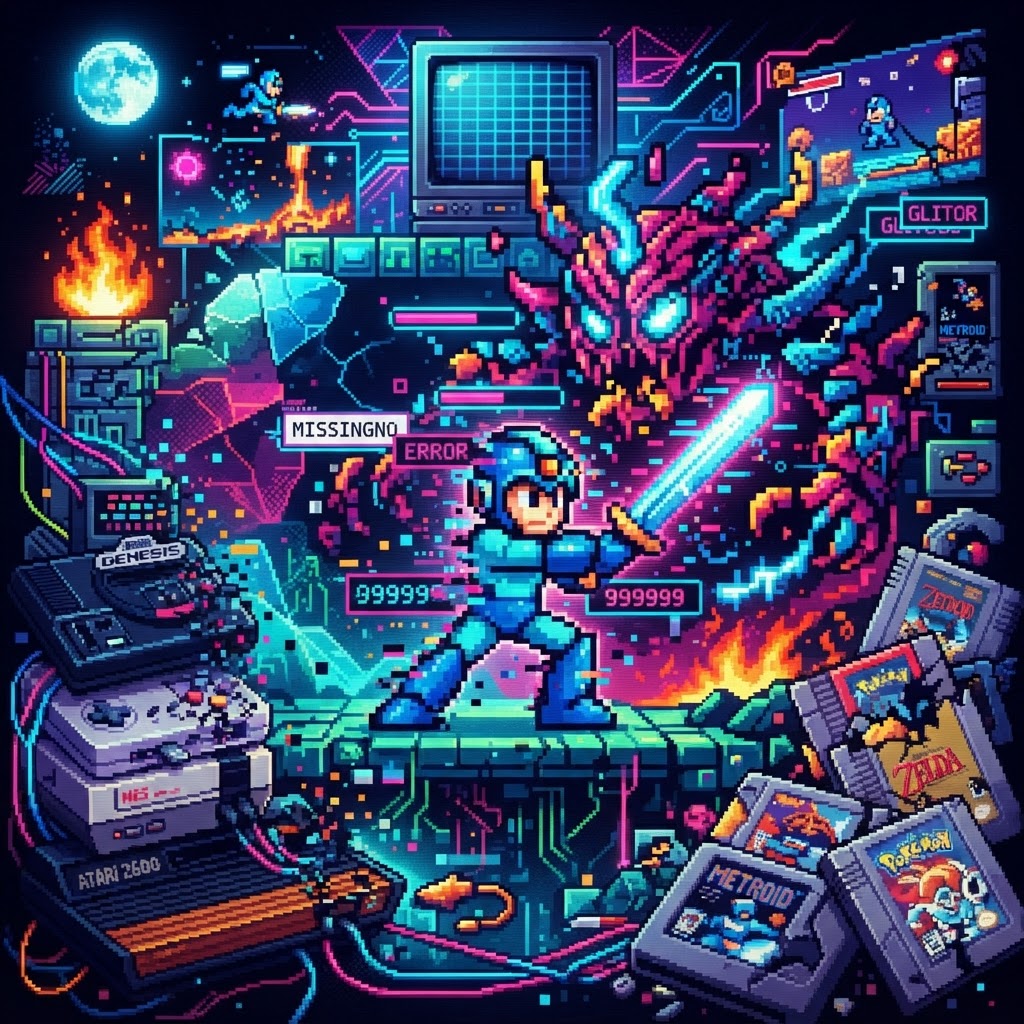
Beyond the MissingNo: Why We Love Broken Code
Most casual players know about the MissingNo glitch in Pokémon Red and Blue, but for the veteran collector, the real stories hide in the obscure, memory-leaking depths of titles that barely held together. Glitches were often the result of programmers working under extreme time constraints, squeezing impossible physics into limited RAM. When you are hunting for these digital anomalies, your hardware needs to be in top shape. If you’re manually swapping carts to trigger these specific game-breaking sequences, I highly recommend using an Anti-Static Cartridge Cleaning Brush to ensure your pins aren't causing extra data corruption that wasn't intended by the developers.
The "Super Monkey" of Ghostbusters (NES)
Often cited as one of the most punishing games of the 8-bit era, the NES port of Ghostbusters hides a secret glitch that turns a difficult game into a surreal nightmare. If you manage to time your screen transitions perfectly, you can trigger a stack overflow that populates the map with unintended, glitched sprites that move through walls. It is a masterclass in unintentional procedural generation. Tracking these moments is a rite of passage, and I personally keep a Retro Gaming Journal & Notebook on my desk to jot down the specific room coordinates and button inputs needed to replicate these "broken" states.
The Legend of Zelda: A Link to the Past – The Underworld Clipping
Advanced players know that the SNES version of Link to the Past is a goldmine for boundary-breaking. By utilizing the "fake flipper" glitch, you can bypass huge sections of the map, effectively walking through the game’s logic. For those who want to study the game’s architecture without risking their original physical hardware, I suggest looking into a USB Cartridge Reader/Dumper. This allows you to safely preserve your save files and explore the memory addresses of these glitches on your computer, providing a deep dive into how Nintendo’s collision detection failed in those specific instances.
Why Glitches Add Value to a Collection
To the uninitiated, a glitch is a nuisance. To the collector, a glitch is a signature of human effort. It reminds us that these worlds were built byte by byte. If your collection is starting to feel like a static museum, remember that the "glitched" state of a game is just as much a part of its identity as the box art.
If you are displaying these notoriously broken classics, don't just shove them on a dusty shelf. Use a Gaming Console Shelf Riser to give your setup the professional, museum-quality aesthetic it deserves. It turns those infamous "broken" cartridges into conversation pieces that highlight the history of software development.
The Search for the "Golden Glitch"
Every collector is looking for that one game that hasn't been fully documented. Are there bugs in Earthbound that we haven't mapped yet? What about the hidden code in early arcade ports? If you're serious about taking your hobby to the next level, I suggest cross-referencing your findings with a Classic Games Collector Reference Book. These resources are invaluable for understanding the context of why certain games were prone to crashing and which production runs were more susceptible to memory corruption.
Final Thoughts for the Advanced Collector
The beauty of retro gaming lies in the imperfections. Whether you're a speedrunner looking to shave seconds off a record or a historian documenting the limitations of 90s technology, these glitches are the "hidden features" that keep our hobby alive. As you continue your hunt, keep your gear clean and your notes organized. There is nothing quite like discovering a new way to break a 30-year-old game, proving that even the most "perfect" classics have a wild, chaotic side waiting to be explored.
Ready to start your own database of digital anomalies? Grab your Retro Gaming Journal & Notebook today and start mapping the glitches that others have missed.