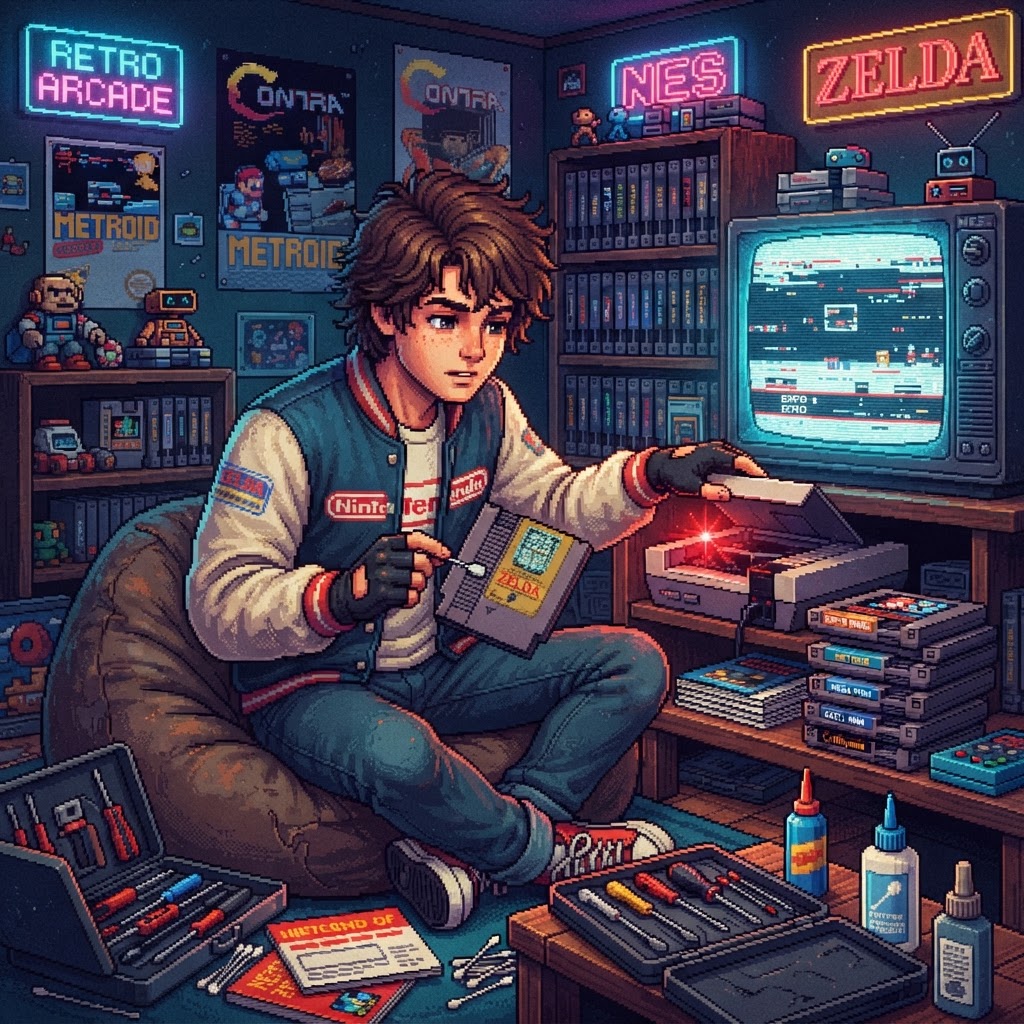
Why NES Collecting Is Still Worth It (And Why It's Complicated)
The Nintendo Entertainment System remains one of the most collected retro platforms on the planet. With over 700 official North American releases, a rich library spanning Mario, Zelda, Mega Man, Castlevania, and beyond, there's no shortage of games to hunt. But collecting NES cartridges in 2024 means confronting nearly 40 years of wear, storage abuse, and counterfeit flooding in the market.
This guide isn't another "top 10 rarest NES games" listicle. Instead, we're going deep on the problems collectors actually encounter — and exactly how to fix them.
Problem #1: The Dreaded Blinking Screen (72-Pin Connector Issues)
If you've owned an original front-loader NES, you know the pain: you insert a cartridge, power on, and get a flashing red power light with no game. This is the most iconic NES problem, and it stems almost entirely from a worn-out 72-pin connector.
Why It Happens
The NES uses a zero-insertion-force (ZIF) tray-style loader — the "toaster" design — that slowly bent and fatigued the 72 metal pins inside the connector over thousands of insertions. Oxidation compounds the problem.
Practical Solutions
- Boiling method: Remove the 72-pin connector, boil it in water for 5–10 minutes, and let it dry. This reshapes the pins temporarily. It's free but not permanent.
- Replace the 72-pin connector: New aftermarket connectors cost under $10 on Amazon or eBay. This is the most reliable long-term fix. Combined with a Retro Console Restoration Tool Kit, you'll have every screwdriver bit and spudger you need to disassemble the NES safely without stripping screws.
- Upgrade to a top-loader NES (AV Famicom or NES 2): The NES 2 (top-loader) uses a different connector design and is far more reliable, though it lacks an RF output.
Problem #2: Dirty or Corroded Cartridge Contacts
Even if your console works perfectly, a cartridge with oxidized or dirty edge contacts will cause graphical glitches, freezes, or failed boots.
Identifying Bad Contacts
Pull out the cartridge board and look at the gold-colored connector strip. Dull, blackened, or greenish contacts mean oxidation. Brown smearing means old cleaning fluid residue.
How to Clean NES Cartridges Properly
- Open the cartridge with a 3.8mm security bit (included in most Retro Console Restoration Tool Kits).
- Use 90%+ isopropyl alcohol on a cotton swab — never blow into cartridges. Saliva introduces moisture and bacteria.
- For heavy oxidation, a pencil eraser gently applied to contacts (followed by an IPA wipe-down) can remove stubborn tarnish.
- Let it dry fully before reinserting.
Pro tip: Never use Windex, WD-40, or household cleaners. These leave residue that accelerates future corrosion.
Problem #3: Spotting Counterfeit NES Cartridges
The NES reproduction and counterfeit market has exploded. Games like Stadium Events, Little Samson, and Panic Restaurant — which sell for hundreds or thousands of dollars — are commonly faked.
Red Flags to Watch For
- Screw type: Authentic NES cartridges use 3.8mm security screws. Many fakes use standard Phillips screws.
- Label quality: Originals have slightly textured labels. Reproductions often look glossy or overly saturated.
- PCB color and markings: Open the cartridge if you can. Official Nintendo boards are typically red or black with clear Nintendo copyright markings. Fake boards are often green with generic chip labels.
- Weight and feel: Authentic shells have a specific heft. Cheap repro shells feel hollow or plasticky.
- Seller history: Buy from reputable retro game stores, not random eBay listings with stock photos.
If you're chasing high-value titles and want to research what authentic versions look like, a Retro Game Strategy Guide Book from the era can also double as a reference for authentic artwork and packaging details.
Problem #4: Poor Video Output on Modern TVs
The NES outputs a composite or RF signal that looks blurry and washed-out on modern flat-panel displays. Worse, many modern TVs introduce input lag that makes fast-paced games like Mega Man 2 or Battletoads nearly unplayable.
Solutions by Budget
Budget option — Composite to HDMI adapter: Basic adapters work but deliver soft, laggy images. Fine for casual play, not ideal for collectors.
Mid-range — RGB modding the NES: The Famicom (and NES with mods) can output RGB video, which is dramatically sharper. Pair this with an Open Source Scan Converter (OSSC) to upscale the signal to HDMI with minimal lag — a favorite among serious collectors and speedrunners alike.
Premium option — FPGA console: The Analogue 3D FPGA Console uses field-programmable gate array technology to replicate original hardware at the circuit level, outputting pristine 4K video with zero emulation lag. It accepts original NES/Famicom cartridges and is considered the gold standard for collectors who want both authenticity and visual quality.
CRT lovers: If you want the authentic scanline look without hunting down a vintage Sony Trinitron, a Premium CRT-Style Gaming Monitor replicates that classic phosphor aesthetic beautifully on modern hardware.
Problem #5: Missing Manuals, Boxes, and Documentation
Complete-in-box (CIB) NES games command serious price premiums — sometimes 3–10x the cartridge-only price. Finding missing inserts, registration cards, and dust sleeves is half the battle.
Where to Source Missing Pieces
- eBay "lot" auctions: Often contain loose manuals and boxes at bulk prices.
- Local game stores and flea markets: Boxes frequently end up separated from carts.
- Replacement printing: Some collectors print high-resolution manual reproductions for personal use. Note: selling reproductions as originals is fraudulent.
- NintendoAge archive / community databases: Detailed documentation of every variant, manual version, and regional difference.
Displaying Your NES Collection Like a Pro
Once you've built your collection and solved the technical headaches, presentation matters. A well-displayed NES collection is a point of pride.
- Use wall-mounted shelving with acrylic risers to show off boxed games.
- Add Retro Gaming Wall Decals to frame your display area with iconic pixel art — Mario, Link, and Mega Man motifs are widely available and instantly recognizable.
- UV-protective display cases help prevent label fading on cartridges exposed to light.
Conclusion: Build Smarter, Collect Better
NES collecting rewards patience and knowledge. The difference between a frustrating hobby and a deeply satisfying one often comes down to having the right tools and knowing what problems to expect. Armed with a proper Retro Console Restoration Tool Kit and the video solutions above, you'll spend less time fighting hardware and more time actually playing the classics.
Start with what you love, learn to spot the fakes, clean your cartridges properly, and invest in a quality display setup. Your future self — surrounded by a glowing shelf of mint-condition NES carts — will thank you.