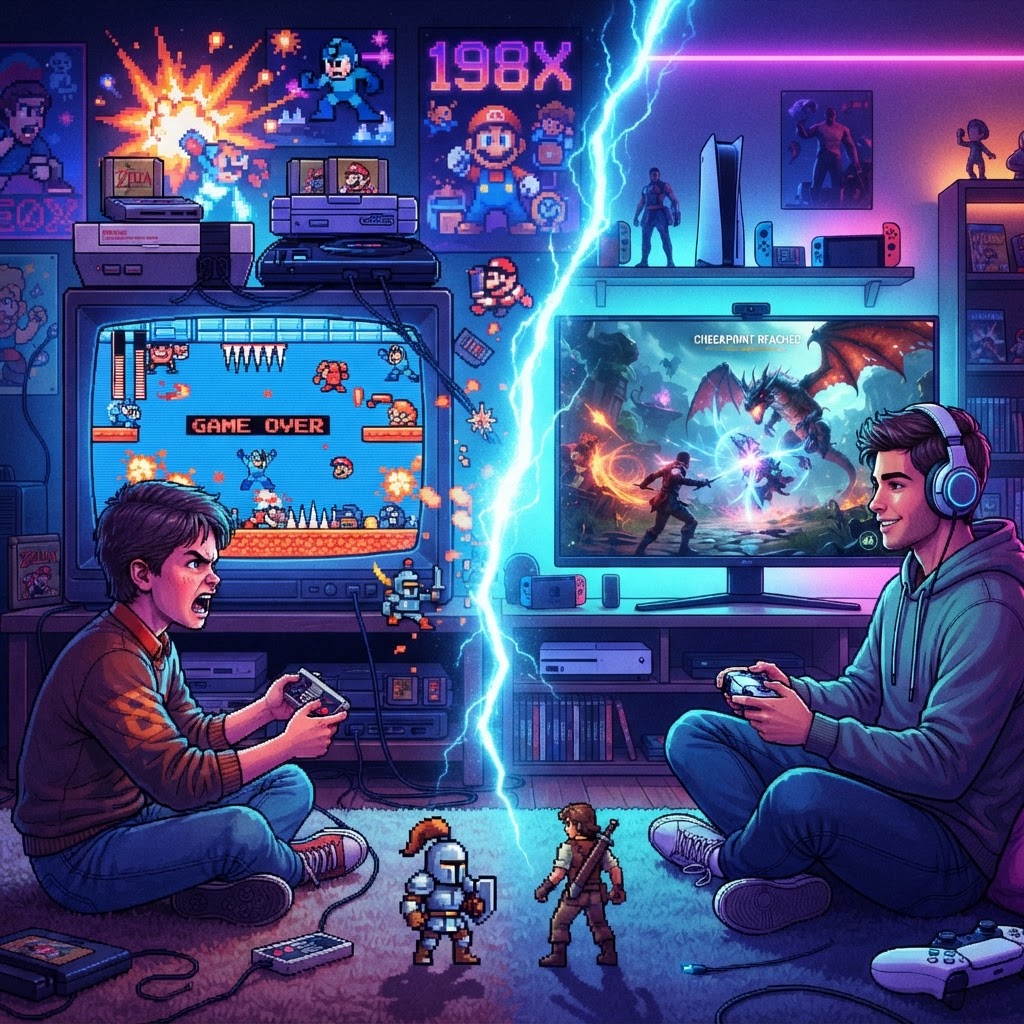
If you grew up pumping quarters into arcade cabinets or blowing dust out of NES cartridges, you remember the "Nintendo Hard" phenomenon. Back then, difficulty wasn't just a setting; it was a business model. Games were designed to be short to save on memory, so developers padded the length by forcing you to replay the same three levels fifty times. Today, we live in the era of "quality of life" features, quest markers, and adjustable difficulty sliders. But which philosophy actually makes for a better gaming experience?
The Arcade Era: Difficulty as a Barrier to Entry
In the 1980s, the goal was simple: get the player to insert another coin. Games were designed to be punishingly difficult because the frustration was directly linked to revenue. This led to a very specific type of game design: pattern recognition. You weren't just playing a game; you were learning a script.
The Pros:
- Unmatched Sense of Accomplishment: Beating a level in Contra or Ghosts 'n Goblins felt like a genuine achievement.
- Mastery Focus: The high stakes forced you to become an expert at the game’s mechanics.
The Cons:
- Artificial Longevity: Sometimes the difficulty felt cheap—pixel-perfect jumps and enemies that respawned instantly.
- Limited Accessibility: Many players never saw the end of the games they bought because the skill floor was simply too high.
If you are looking to relive that high-stakes, authentic arcade feel, you’ll need the right gear to ensure your inputs are as precise as possible. Serious enthusiasts often upgrade their setups with an Arcade Cabinet Joystick Kit to regain that tactile, arcade-perfect responsiveness that modern gamepads often lack.
The Modern Era: Difficulty as an Accessibility Feature
Modern gaming has pivoted toward the "player-first" philosophy. Developers now view difficulty as a barrier to story engagement rather than a mechanic for length. Features like "Story Mode," auto-aim, and checkpoints mean that almost anyone can reach the credits of a major release.
The Pros:
- Inclusive Design: Games are now accessible to people with varying skill levels and physical abilities.
- Cinematic Focus: Removing the stress of constant failure allows players to soak in the narrative and world-building.
The Cons:
- The "Cruise Control" Effect: When everything is easy, the player often stops engaging with the game’s core mechanics, leading to a passive, "check-the-boxes" experience.
- Loss of Tension: When death has no consequence, the stakes of the story often feel significantly lower.
Side-by-Side: Which Experience Do You Want?
| Feature | Retro Era (Difficulty-First) | Modern Era (Accessibility-First) | | :--- | :--- | :--- | | Pacing | Punishing, requires repetition | Fluid, forward-moving | | Player Engagement | Mechanical Mastery | Narrative/Exploration focus | | Failure Penalty | Restart level/Game Over | Immediate respawn/No penalty | | Goal | Conquer the system | Experience the world |
Finding the Balance: How to Curate Your Own Difficulty
Whether you prefer the brutal challenges of the past or the breezy adventures of the present, the key to a great gaming experience is environment. When you're tackling a notoriously difficult retro title, you need to be comfortable for those long "trial and error" sessions. Investing in a dedicated Retro Gaming Recliner Chair can make the difference between a frustrating evening and an immersive marathon.
If you are a fan of that classic, punishing difficulty, you might also find that modern hardware doesn't always capture the charm of the originals. For those who want the true retro experience on the go—without sacrificing that tactile difficulty—the Analogue Pocket FPGA Handheld is widely considered the gold standard, providing zero-lag, authentic gameplay that tests your skills exactly the way the developers intended in 1989.
Conclusion: The Choice is Yours
The evolution of game difficulty isn't a story of "better" or "worse," but a story of different goals. Retro gaming pushes you to become a better player, while modern gaming invites you to become a better observer. The best part about the hobby today? You don't have to choose. You can spend your morning mastering a brutal 8-bit platformer and your evening relaxing with a narrative-driven modern epic.
Regardless of your preference, make sure your gaming den is optimized for the long haul. Grab an Analogue Pocket FPGA Handheld today and start testing your skills against the most legendary challenges in gaming history.