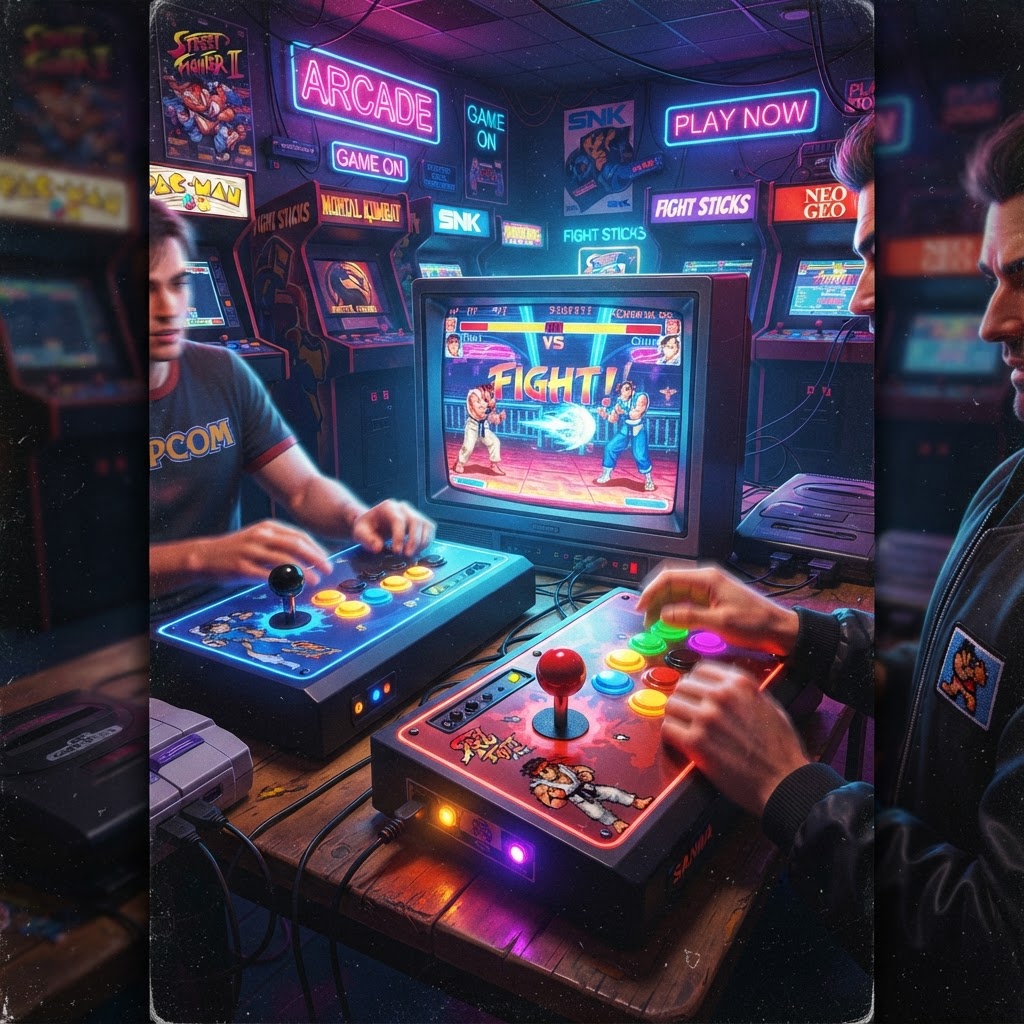
Why a Quality Fight Stick Is a Long-Term Investment Worth Making
If you've spent any time hunting down authentic Street Fighter II cabinets, dusting off your SNES copy of Mortal Kombat, or building a MAME library that could make an arcade operator weep with jealousy, you already understand the value of authenticity. Playing retro fighting games with a quality arcade fight stick isn't just a preference — it's the correct way to experience titles that were literally designed around arcade hardware.
But here's the thing most buyers get wrong: they treat a fight stick like a disposable accessory. The smart retro gaming community knows better. A premium fight stick, paired with the right setup, is an investment. The best ones use Sanwa or Seimitsu components — the same Japanese parts found in arcade cabinets that survived decades of coin-op punishment. When you buy smart, you buy once.
This guide breaks down exactly what to look for, which features drive long-term durability, and how to build a retro fighting setup that will still be delivering satisfying Hadoukens in 2035.
What Makes an Arcade Fight Stick "Built to Last"?
Component Quality: The Foundation of Durability
The single most important factor in fight stick longevity is the quality of its internal components — specifically the joystick gate and the buttons.
- Sanwa Denshi JLF and Seimitsu LS-32 joysticks are the gold standard. Both are used in commercial arcade machines and are rated for millions of inputs. If a fight stick ships with either, that's a green flag.
- 30mm Sanwa OBSF buttons are similarly rated for 10+ million presses. Cheap membrane buttons on budget sticks start to stick, double-input, or fail within months of heavy use.
- PCB (printed circuit board) quality matters enormously. Multi-platform PCBs from brands like Brook are worth the premium — they're compatible with PS4, PS5, Xbox, PC, and legacy platforms, meaning your stick doesn't become obsolete when you switch systems.
The best fight sticks on the market today — from brands like Hori, Qanba, and Razer — use these commercial-grade components. They're not cheap upfront, but they're dramatically cheaper than replacing a budget stick every two years.
Build Materials: Wood vs. Acrylic vs. Plastic
Wooden enclosures (like those found on custom sticks from Korean-style builders) tend to outlast acrylic and injection-molded plastic. That said, high-density ABS plastic used by companies like Qanba can be remarkably durable when engineered properly.
Look for:
- Heavy base weight (prevents sliding during intense play)
- Reinforced USB cable ports (a common failure point on cheaper sticks)
- Removable top panels (allows artwork replacement and future upgrades)
Top Arcade Fight Stick Picks for Retro Gaming Enthusiasts
1. Hori Real Arcade Pro Series (RAP N Hayabusa)
The Hori RAP N remains one of the most respected sticks in the community for good reason. It ships with Hori's own Hayabusa joystick and Kuro buttons — both engineered to Sanwa-equivalent tolerances. The PC and PS4 compatibility makes it versatile for emulation setups, and the build quality is legitimately arcade-grade.
Best for: Street Fighter II, King of Fighters, Samurai Shodown Long-term value: Excellent — Hayabusa parts have a stellar reliability record and replacements are widely available.
2. Qanba Obsidian 2
The Qanba Obsidian 2 is arguably the best mid-tier fight stick for retro gamers who want authentic Sanwa components without breaking the bank. It ships with genuine Sanwa JLF joystick and OBSF-30 buttons straight out of the box — no modding required. The acrylic panel is removable for custom artwork, making it a favorite for collectors who want their stick to match their aesthetic.
Best for: Capcom fighters, SNK classics, MAME setups Long-term value: Outstanding — Sanwa parts are among the most repairable and replaceable in the hobby.
3. Razer Panthera Evo (Sanwa Edition)
The Panthera Evo is a premium all-metal enclosure stick that ships with Sanwa parts. Its storage compartment and tool-less mod system make it uniquely repairable and upgradeable — a major plus for long-term ownership. It connects natively to PC and PS4/PS5, covering virtually every retro emulation platform you'd want.
Best for: Serious retro tournament play, collectors who value premium build quality Long-term value: Very high — the all-metal chassis essentially doesn't age.
Building the Ultimate Retro Fighting Setup Around Your Stick
A great fight stick deserves a great setup. Here's how to maximize your retro fighting experience:
Your DIY Option: The Arcade Cabinet Joystick Kit
For the builders and tinkerers in the community, assembling your own stick or upgrading an existing cabinet using an Arcade Cabinet Joystick Kit is the ultimate path to long-term value. These kits typically include Sanwa or equivalent joysticks and buttons, allowing complete customization of your feel, layout, and weight. You own every component outright, repairs are trivial, and the total cost over a lifetime is lower than buying pre-built sticks every few years.
The Display: Get the Visuals Right
Playing Street Fighter Alpha or Garou: Mark of the Wolves on a modern display with input lag and oversaturated colors is a crime against retro gaming. A Premium CRT-Style Gaming Monitor gives you scanline aesthetics and near-zero input lag — critical for frame-tight fighting game inputs. Combined with a quality stick, the experience genuinely replicates the arcade feel.
The Platform: Pixel-Perfect Accuracy Matters
For retro fighting games to feel right, your hardware needs to run them accurately. The Analogue 3D FPGA Console uses field-programmable gate array technology to replicate original hardware at the cycle-accurate level — meaning your inputs, animations, and hitboxes behave exactly as they did on original hardware. No emulation lag, no approximation. For competitive retro play, this matters.
The Environment: Comfort for Long Sessions
Long training sessions and tournament marathons demand physical comfort. A purpose-built Retro Gaming Recliner Chair supports proper posture and reduces fatigue, letting you focus entirely on execution rather than your back. It sounds like a luxury — until you've lost a match because your arm was cramped.
The Atmosphere: Set the Arcade Mood
Ambiance is part of the experience. Adding a Retro Gaming LED Backlight Strip behind your monitor or beneath your cabinet transforms your space into something that actually feels like the arcade era. It's an inexpensive touch that dramatically elevates immersion.
Fight Stick Maintenance: Protecting Your Investment
Even the best hardware needs care. Here's how to extend the life of your fight stick:
- Clean buttons regularly — Dust and debris cause early button failure. A can of compressed air and occasional isopropyl wipe-down keeps contacts clean.
- Re-lubricate the joystick gate — Use Shin-Etsu grease (not WD-40) on the pivot point every 12-18 months of heavy use.
- Check and re-solder USB connections — The cable port endures mechanical stress. Inspect it annually and re-solder if any looseness develops.
- Store properly — Avoid direct sunlight on acrylic panels and keep sticks in cases or bags when not in use.
Conclusion: Buy Once, Play Forever
The retro fighting game community deserves hardware that honors the games they love. A premium arcade fight stick with genuine Sanwa or Seimitsu components, paired with an accurate display and quality platform, isn't an expense — it's infrastructure. You're building a setup that will be relevant and enjoyable for decades, not just the next console generation.
Start with your foundation: grab an Arcade Cabinet Joystick Kit if you're the DIY type, or invest in a Qanba Obsidian 2 or Hori RAP N for a ready-to-play premium experience. Either path leads to the same destination — authentic, durable, satisfying retro fighting gameplay that was designed to be played exactly this way.
The Shoryuken feels better when your hardware is worthy of it.