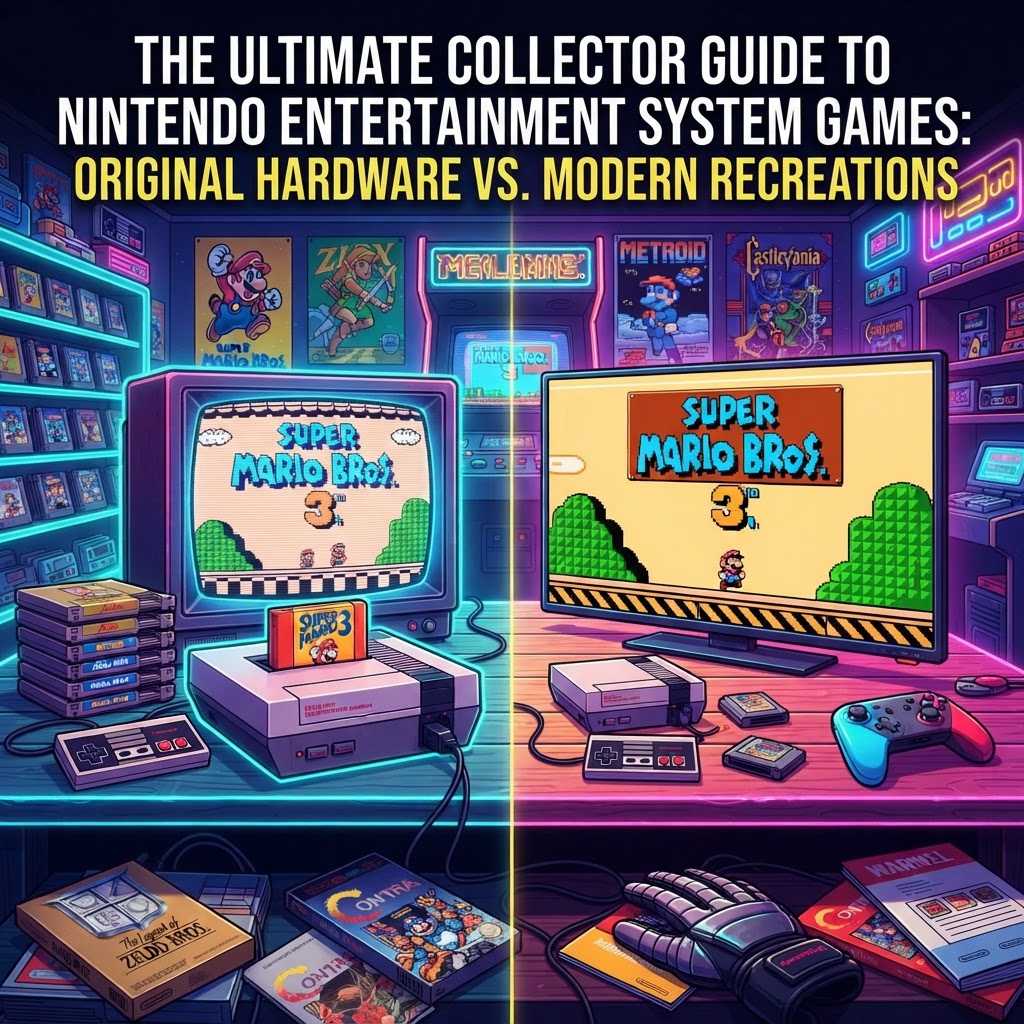
The Ultimate Collector Guide to Nintendo Entertainment System Games: Original Hardware vs. Modern Recreations
Whether you're hunting down a mint-condition Earthbound cartridge or deciding whether a modern NES emulator is "good enough," this guide cuts through the noise to help you build a smarter, more rewarding NES collection in 2024.
Why NES Games Are Still Worth Collecting in 2024
The Nintendo Entertainment System didn't just save the video game industry after the crash of 1983 — it built an entire culture. Decades later, that culture is more vibrant than ever. NES cartridges are actively traded on eBay, at retro game fairs, and through dedicated collector communities. Prices for rare titles like Little Samson, Stadium Events, and Panic Restaurant have soared into the hundreds or thousands of dollars, yet the barrier to entry for the casual collector remains refreshingly low. You can still pick up beloved classics like Super Mario Bros., Mega Man 2, and Contra for under $20 a pop.
But here's the question that splits every collector community right down the middle: Should you play and collect original vintage NES hardware and cartridges, or lean into modern recreations like the NES Classic Mini, FPGA clones, or handheld emulators?
This guide answers that question honestly — and helps you build the best collection strategy for your goals, budget, and living room.
Original NES Hardware: The Authentic Experience (And Its Real Drawbacks)
What You Actually Get With Vintage Cartridges
There is nothing quite like sliding a real NES cartridge into an original Famicom or front-loading NES and hearing that satisfying click. Original cartridges preserve something modern recreations simply cannot replicate: the physical artifact of gaming history. The box art, the instruction manual, the label wear — these are time capsules.
From a collector's perspective, original cartridges have clear advantages:
- Real monetary value. Graded games (via Wata or VGA) command real prices at auction. A sealed copy of Super Mario Bros. sold for over $2 million in 2021.
- Full game libraries. No licensing gaps. Every officially released NES game exists on cartridge, including regional exclusives.
- Tactile authenticity. The feel of the hardware, the RF or composite signal on a CRT — for many, this IS the point.
The Honest Downsides of Original Hardware
Let's not romanticize the NES too hard. The original front-loading NES is notorious for its unreliable 72-pin connector, causing the infamous blinking red light. The Zero Insertion Force (ZIF) connector degraded over 30+ years of use, and most original units will need a connector replacement or cleaning before reliable play.
More critically, many NES cartridges use CR2032 batteries to save game data, and those batteries die. If you've picked up a copy of The Legend of Zelda or Metroid and can't save, chances are the save battery has failed. Replacing it is entirely doable — you'll want a Replacement Game Cartridge Save Battery and a basic soldering kit — but it's an extra step that intimidates new collectors.
Opening cartridges for maintenance also carries electrostatic discharge risk. Always use an Anti-Static Wrist Strap when working inside cartridges or the console itself to avoid frying decades-old silicon that simply cannot be replaced.
Modern Recreations: FPGA Clones, the NES Classic, and Handhelds
FPGA Clones: The Closest Thing to the Real Deal
Field-programmable gate array (FPGA) consoles — like the Analogue Nt Mini Noir or the Mister FPGA — are not emulators in the traditional software sense. They recreate the NES hardware at a circuit level, producing output that is nearly indistinguishable from original hardware. They accept real cartridges (on some models), output via HDMI, and add features like scanline filters and save states.
For the serious collector who wants to actually play their cartridges without stressing the original hardware, an FPGA solution is arguably the best of both worlds.
The NES Classic Mini: A Great Gateway, Not a Replacement
Nintendo's own NES Classic Edition (released 2016, discontinued and re-released multiple times) packed 30 games into a tiny replica console for $60. It's fantastic for casual play and looks great on a shelf, but it's a closed ecosystem — no cartridge slot, only 30 games, no expansion.
Handheld Emulators: Portability Wins
For collectors who want to play their ROMs on the go or experience the full NES library without hunting cartridges, a quality Handheld Retro Gaming Console is a fantastic complement to a physical collection. Modern handhelds running RetroArch can emulate NES with pixel-perfect accuracy, support save states, and fit in your pocket.
If you want a premium portable experience with the power to run not just NES but SNES, N64, PSP, and beyond, the Steam Deck Handheld Gaming PC is the most powerful option on the market today — it runs RetroArch beautifully and can serve as the backbone of a serious retro gaming setup.
Original vs. Modern: Which Is Better for Collectors?
For Display and Investment Value: Original Hardware Wins
If your goal is to build a collection with monetary and historical value, nothing replaces authentic cartridges, boxes, and manuals. Original hardware in working condition is what commands prices at auction. FPGA clones and NES Classic minis will never appreciate in the same way a sealed Ducktales cartridge will.
For Everyday Play: Modern Recreations Win
Playing your collection regularly on original 40-year-old hardware accelerates wear. Save batteries die. Connectors corrode. A smart collector preserves the originals for display and uses a clone or emulator for daily play sessions. This is not a compromise — it's smart stewardship.
For the Budget Collector: Start Modern, Graduate to Vintage
If you're just getting into NES collecting, begin with a handheld emulator to explore the library and identify which games you truly love enough to hunt down physically. Then start building your cartridge collection intentionally.
Setting Up Your NES Collector Space Right
A great collection deserves a great display. A few upgrades make a real difference:
- Atmosphere: LED Strip Lights for Gaming Room behind shelving create a stunning backlit effect that makes your cartridge display pop.
- Travel protection: Taking your hardware to retro game fairs or a friend's place? A Retro Console Travel Bag keeps your gear protected in transit.
- Display accessories: Round out the retro vibe on your gaming desk with a Retro Gaming Coasters Set — a small touch that signals serious collector energy.
Key Buying Tips for NES Game Collectors
- Check cartridge authenticity. Counterfeit NES carts are common. Look for proper Nintendo markings, correct PCB color (usually red or black), and matching label fonts.
- Grade your grails. For investment-grade purchases, consider professional grading through Wata Games.
- Buy loose first, upgrade later. Cartridge-only is fine to start. Boxes and manuals can be sourced separately.
- Know your region. NTSC (North American) and PAL (European) games are not interchangeable on original hardware without modification.
- Prioritize condition over quantity. Ten great-condition carts beat fifty beaten-up ones every time.
Conclusion: Build Your NES Collection the Smart Way
The debate between original NES hardware and modern recreations doesn't have a single winner — it has a smart strategy. Collect original cartridges for their historical value, display them proudly, and protect them. Use a quality handheld emulator or FPGA clone for everyday play. Maintain what you own with the right tools, starting with a Replacement Game Cartridge Save Battery for any RPG or adventure title in your collection.
The NES library is one of gaming's greatest treasures. Collect it wisely, and it'll reward you for decades to come.