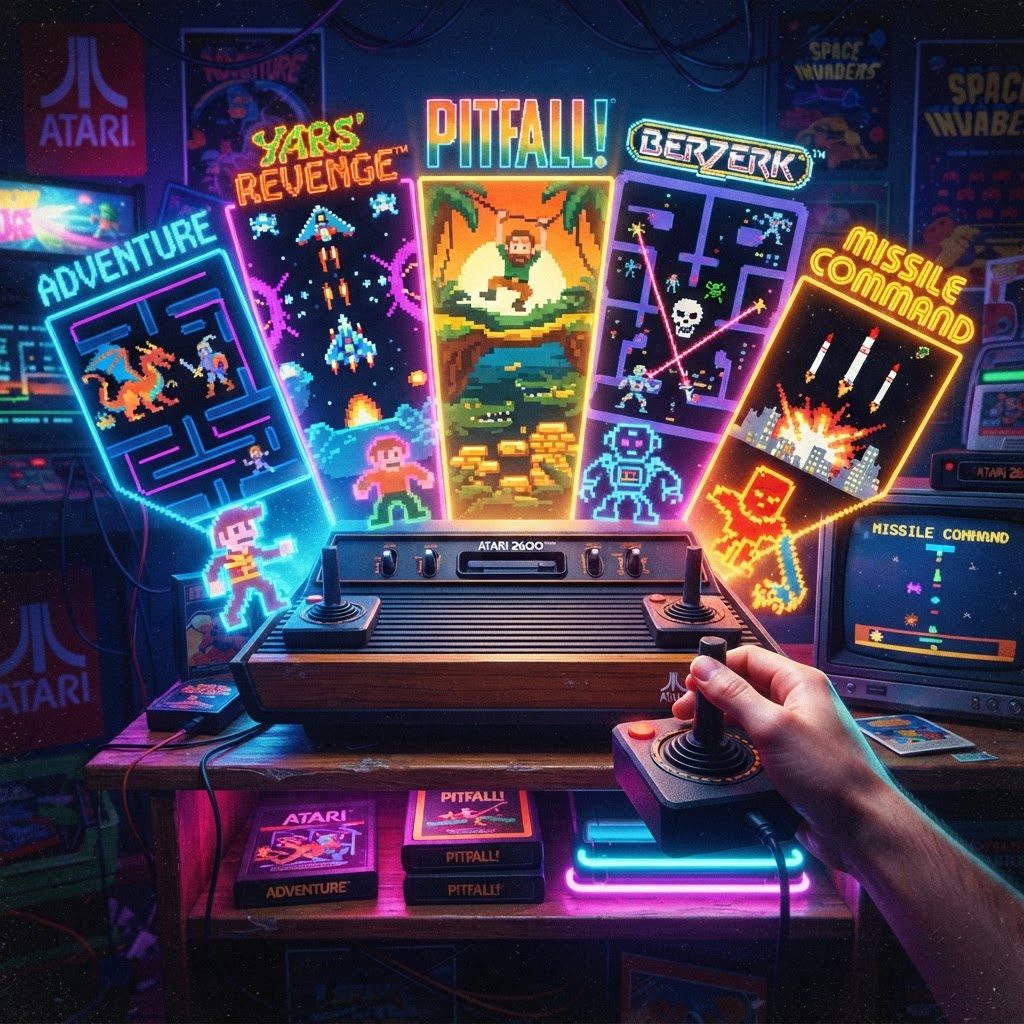
When we look back at the Atari 2600 era, it is easy to fixate on the "Big Three"—Pac-Man, Space Invaders, and Pitfall!. However, the true story of how gaming evolved lies in the margins. It was in the dimly lit offices of early third-party developers that the concepts of non-linear exploration, environmental storytelling, and complex AI were born. These forgotten Atari games didn't just fill our living rooms with pixels; they wrote the rulebook for every title in your modern library.
The Evolution of the "Sandbox" Concept: Adventure (1980)
While many remember Adventure for its simple blocky graphics, it was actually the first "Action-Adventure" game ever created. It introduced the concept of a persistent world—one where items remained exactly where you dropped them, even if you left the screen.
If you are lucky enough to still own an original cartridge of these historical artifacts, you know they require care. To ensure your vintage hardware stays pristine for decades to come, consider housing your collection in a Retro Console Glass Display Case. Protecting your legacy gear is the first step in preserving gaming history.
Building the Foundation of Stealth: Berzerk (1982)
Berzerk was a terrifying lesson in procedurally generated danger and AI pressure. It taught players that movement wasn't just about offense—it was about survival through evasion. It was one of the first games to feature a taunting, synthesized voice, a precursor to the environmental narrative techniques we see in modern titles.
The Birth of the Isometric Perspective: Congo Bongo (1983)
Most players remember Donkey Kong, but Congo Bongo was the trailblazer for the isometric perspective on the Atari. By adding depth to the playfield, it forced players to judge distance and spatial awareness in a way that had never been required before. It proved that 2D sprites could exist in a 3D-feeling space, paving the way for the platformers that would dominate the 90s.
Why These Games Matter Today
Understanding these titles provides context for why we love the games we play today. Whether you are running a modern Steam Deck Handheld Gaming PC to emulate classics or playing the latest AAA blockbuster, the DNA of Atari’s "forgotten" era is present in every input and every line of code.
However, playing these games on modern displays can be a challenge. If you want to experience the true, sharp output of an original Atari console on a 4K TV, the RetroTINK 4K Video Upscaler is an absolute necessity. It cleans up the signal, allowing the deliberate pixel art of the early 80s to shine without the muddy blur of standard composite cables.
Maintaining Your Pieces of History
Collecting Atari games isn't just about buying; it’s about restoring and maintaining. If your vintage console is suffering from oxidation or flickering connections, a routine cleaning with Isopropyl Alcohol Contact Cleaner can often be the difference between a dead console and one that boots on the first try.
For those who are a bit more hands-on, don't be afraid to perform basic maintenance. With a reliable Retro Console Repair Soldering Kit, you can replace capacitors or repair loose joystick ports, ensuring these industry-pioneering machines survive for future generations to discover.
Conclusion: Keep the Legacy Alive
These forgotten Atari games are more than just digital relics; they are the blueprints of an industry that now spans the globe. By seeking out these titles and keeping our hardware in top condition, we keep the history of gaming vibrant and accessible.
Are you ready to start your journey into the preservation of these legends? Grab a Retro Console Glass Display Case today and give your Atari collection the museum-quality home it deserves.